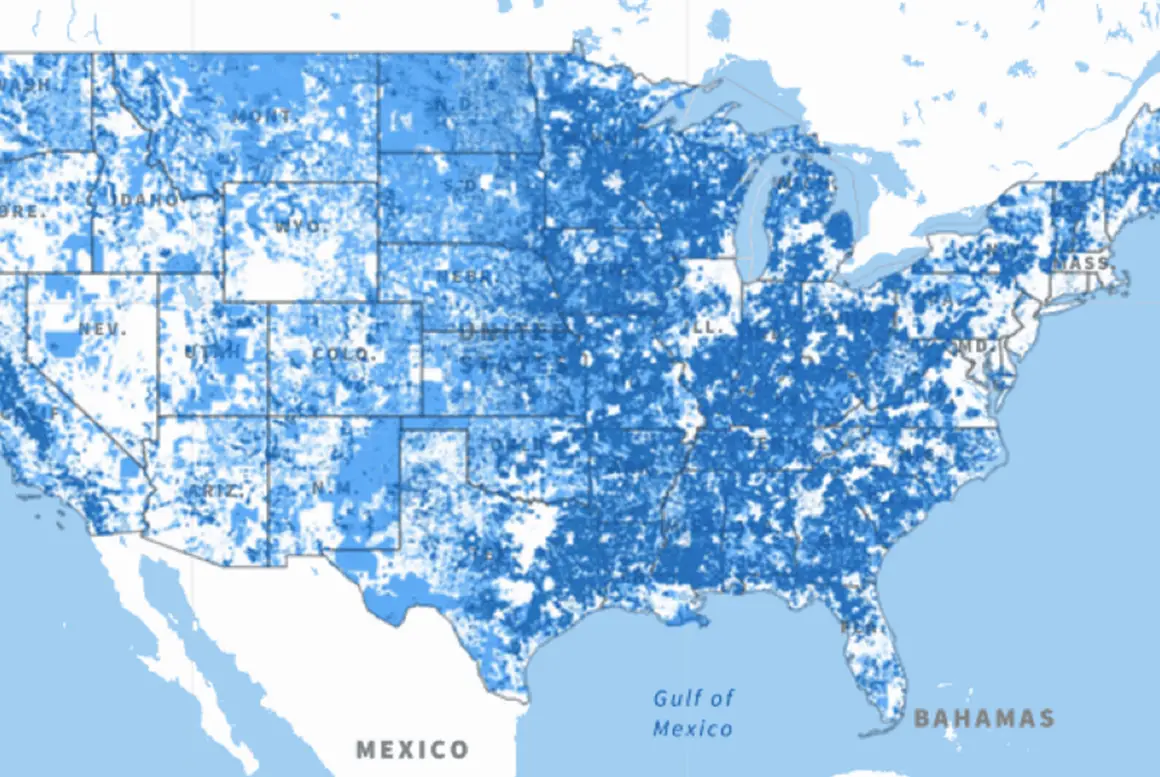
America’s Hidden Connectivity Gap: The Real Story Behind FCC’s Broadband Maps
New Audit Shows 26 Million Americans Still Offline—Far Exceeding FCC’s Reported 19.6 Million.
In late 2024, a team of analysts started running address-by-address internet tests across the country. What they found didn’t match the official story.
While the Federal Communications Commission (FCC) reported that 19.6 million Americans lacked access to broadband speeds of 100 Mbps download and 20 Mbps upload, the ground reality told a different tale. Independent verification across 109,473 internet addresses revealed that closer to 26 million Americans remain without access to such service — a 6.4 million-person gap, or roughly a 33% undercount.
This is more than a data discrepancy. It’s a digital equity problem with billions in funding and millions of lives on the line.
Why the Numbers Matter
Reliable fiber internet and high-speed Wifi connections are no longer luxuries. They’re essential for work, education, healthcare, and economic growth. Congress has tied most federal broadband subsidies, including the $42.45 billion BEAD program, to the FCC’s broadband maps.
But the issue lies in how “service availability” is defined. The FCC considers a location served if one provider claims it could offer service there. This self-reported model, often relying on provider estimates, doesn’t always match what residents actually experience when they try to order real broadband plans or home internet packages.
Researchers from Talk Walk Connection tested this by blending ISP data crawls and real-world purchase attempts. Their results raised three urgent questions:
- How big is the national undercount of unserved Americans?
- Which states face the most severe mapping gaps?
- What policies can close these blind spots before billions in broadband funds are distributed?
Key Findings: What the Data Reveals
- A 33% Nationwide Undercount
The FCC’s maps list 19.6 million Americans as unserved. The independent audit shows 26 million actually lack access to 100/20 Mbps speeds — an additional 6.4 million people disconnected from reliable home internet.
- Technology-Specific Overreporting
The biggest discrepancies appear in the newest fiber optics networks. While these promise high-speed fiber internet, many of the listed “served” addresses cannot yet order such plans.
| Access Technology | FCC “Served” Locations Found Unserviceable | Overreporting Rate |
|---|---|---|
| Fiber | 66.5% | Highest error; many planned builds not yet operational |
| Fixed Wireless | 44.6% | Upload and capacity limits cause shortfalls |
| Cable | 14.5% | Issues persist in areas with outdated infrastructure |
Even in areas with “fiber connection” claims, two-thirds of addresses were unable to get active service.
- State-Level Gaps
Mapping errors are not evenly distributed. The largest relative undercounts appear in the Plains, Mountain West, and Sunbelt states, where geography and provider filings skew accuracy.
| Rank | State | FCC Undercount | Relative Gap |
|---|---|---|---|
| 1 | Iowa | 195,000 | +62.6% |
| 2 | New Mexico | 161,000 | +61.0% |
| 3 | Mississippi | 264,000 | +55.2% |
| 4 | Mississippi | 264,000 | +55.2% |
| 5 | South Dakota | 68,000 | +52.8% |
Larger states like California, Texas, and Florida also have the most people affected — with hundreds of thousands still unable to access reliable business internet or home internet despite being marked as “served.”
| Rank | State | FCC Undercount |
|---|---|---|
| 1 | California | 446,000 |
| 2 | Texas | 444,000 |
| 3 | Florida | 392,000 |
| 4 | North Carolina | 272,000 |
| 5 | Alabama | 270,000 |
The Broadband Reality Gap Across States
The table below shows how much each state’s actual connectivity diverges from FCC’s reported data. The overreporting percent measures how far off the maps are — indicating how many residents appear served on paper but aren’t in practice.
| State | Overreporting % | FCC’s Unserved Americans | Unserved Americans | State Population |
|---|---|---|---|---|
| Alabama | 38.5 | 701,393 | 971,517 | 5,108,468 |
| Arizona | 55.1 | 359,677 | 557,905 | 7,431,344 |
| Arkansas | 40.3 | 351,255 | 492,827 | 3,067,732 |
| California | 28.1 | 1,589,780 | 2,036,000 | 38,965,193 |
| Colorado | 37.3 | 270,370 | 371,327 | 5,877,610 |
| Connecticut | 24.6 | 90,791 | 113,123 | 3,617,176 |
| Delaware | 43.5 | 16,201 | 23,249 | 1,031,890 |
| Florida | 33.7 | 1,164,452 | 1,556,814 | 22,610,726 |
| Georgia | 35.0 | 687,121 | 927,741 | 11,029,227 |
| Idaho | 48.4 | 208,457 | 309,452 | 1,964,726 |
| Illinois | 25.4 | 466,848 | 585,588 | 12,549,689 |
| Indiana | 29.0 | 373,990 | 482,533 | 6,862,199 |
| Iowa | 62.6 | 146,560 | 238,329 | 3,207,004 |
| Kansas | 29.9 | 177,315 | 230,302 | 2,940,546 |
| Kentucky | 37.4 | 520,960 | 716,007 | 4,526,154 |
| Louisiana | 37.2 | 639,867 | 878,052 | 4,573,749 |
| Maine | 25.9 | 156,321 | 196,779 | 1,395,722 |
| Maryland | 10.0 | 120,515 | 132,566 | 6,180,253 |
| Massachusetts | 8.2 | 70,014 | 75,728 | 7,001,399 |
| Michigan | 27.9 | 764,839 | 977,971 | 10,037,261 |
| Minnesota | 43.6 | 302,388 | 434,118 | 5,737,915 |
| Mississippi | 55.2 | 478,582 | 742,534 | 2,939,690 |
| Missouri | 32.4 | 477,104 | 631,609 | 6,196,156 |
| Montana | 43.5 | 226,449 | 325,050 | 1,132,812 |
| Nebraska | 45.3 | 130,969 | 190,361 | 1,978,379 |
| Nevada | 45.6 | 25,873 | 37,676 | 3,194,176 |
| New Hampshire | 23.0 | 43,464 | 53,470 | 1,402,054 |
| New Jersey | 12.9 | 142,150 | 160,418 | 9,290,841 |
| New Mexico | 61.0 | 203,402 | 327,386 | 2,114,371 |
| New York | 22.3 | 587,136 | 718,302 | 19,571,216 |
| North Carolina | 27.9 | 974,111 | 1,245,769 | 10,835,491 |
| North Dakota | 40.7 | 8,623 | 12,136 | 783,926 |
| Ohio | 27.4 | 723,656 | 922,209 | 11,785,935 |
| Oklahoma | 35.3 | 338,900 | 458,545 | 4,053,824 |
| Oregon | 41.3 | 308,188 | 435,622 | 4,233,358 |
| Pennsylvania | 21.7 | 588,460 | 716,098 | 12,961,683 |
| Rhode Island | 28.9 | 29,591 | 38,137 | 1,095,962 |
| South Carolina | 34.8 | 310,054 | 417,805 | 5,373,555 |
| South Dakota | 52.8 | 49,827 | 76,145 | 919,318 |
| Tennessee | 32.6 | 374,141 | 496,261 | 7,126,489 |
| Texas | 27.6 | 1,607,524 | 2,051,770 | 30,503,301 |
| Utah | 40.0 | 132,608 | 185,692 | 3,417,734 |
| Vermont | 13.6 | 87,667 | 99,629 | 647,464 |
| Virginia | 17.1 | 630,145 | 737,802 | 8,715,698 |
| Washington | 41.3 | 604,717 | 854,742 | 7,812,880 |
| West Virginia | 41.8 | 414,374 | 587,776 | 1,770,071 |
| Wisconsin | 29.1 | 871,275 | 1,125,199 | 5,910,955 |
| Wyoming | 33.1 | 63,137 | 84,018 | 584,057 |
| Total (Nationwide) | 33.0 | 19,611,241 | 26,040,089 | — |
The High Cost of Bad Maps
A 33% mapping error has serious financial consequences. Based on BEAD’s $42.5 billion allocation formula, as much as $14 billion in funding could be misdirected away from the regions that need fiber connection and high-speed internet plans most.
What’s at Risk:
- Misallocated BEAD funds: States with the worst mapping errors may receive less funding than needed.
- Overbuild vs. Oversubscription: Some areas appear “served” but still can’t get reliable home internet or business internet access.
- RDOF Compliance Gaps: Around 2 million of the undercounted Americans live in federally funded census blocks that remain partially unbuilt.
- Affordability Initiatives: The next generation of subsidy programs needs more than eligibility maps — it needs proof of actual performance.
How the Data Was Collected
| Component | Source | Purpose |
|---|---|---|
| FCC Availability Baseline | Broadband Data Collection v2 (January 2022) | Establishes the official count of “served” and “unserved” locations used in federal broadband maps. |
| Manual Address Audit | 109,473 ISP-address tests (October 2024 – March 2025) | Independently verifies whether a 100/20 Mbps broadband plan can actually be ordered at each address. |
| Provider Plan Crawler | Talk Walk Connection engine | Compiles available plan speeds and technologies, including fiber internet, cable, and fixed wireless access (FWA), to classify connection types. |
A location was only marked “served” if at least one ISP’s live checker confirmed service availability and displayed a purchase option for a 100/20 Mbps plan. If all plans were slower, or unavailable, the address was labeled unserved, regardless of what the FCC’s maps claimed.
The Bottom Line
This isn’t just about coverage maps — it’s about opportunity. Millions of Americans remain digitally invisible because of flawed reporting. Without accurate data, fiber internet expansion, home internet packages, and broadband plans risk being distributed unfairly.
Accurate mapping ensures every community, from rural plains to suburban edges, can access reliable high-speed fiber internet. The digital divide can’t be closed with wishful numbers. It requires transparency, verification, and an honest look at where the connections really end.